Pat Parsons Pens Memories of Bygone Cape Charles
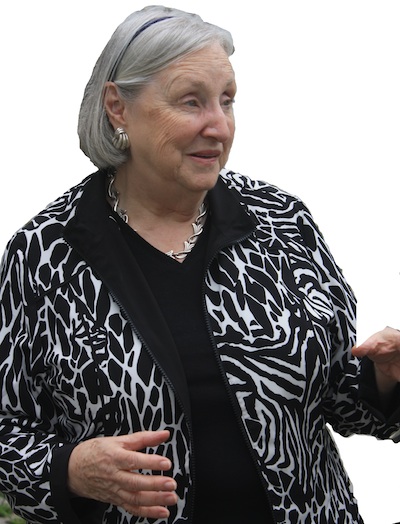
Author Pat Parsons has nearly finished her book about growing up in Cape Charles, entitled “Before We Were Quaint.” (Wave photo)
By DORIE SOUTHERN
Cape Charles Wave
July 28, 2014
When Pat Parsons left home 59 years ago to attend Radford College, Cape Charles was far different from now: a bustling railroad town with a ferry connecting to Norfolk. Now Parsons has nearly completed a book of memories of those bygone days.
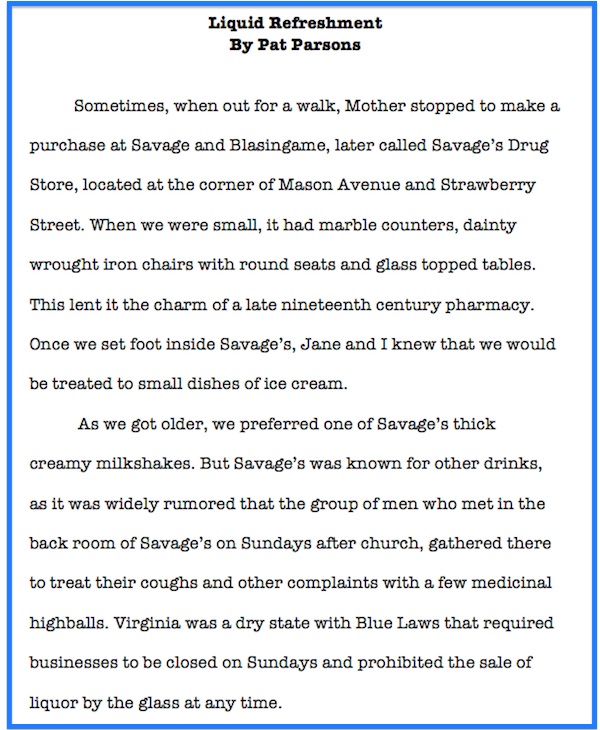
During breakfast earlier this year at the Cape Charles Coffee House, Parsons mentioned to proprietor Roberta Romeo that she was writing vignettes of growing up in Cape Charles in order to share her memories with her grandchildren. At Romeo’s urging, Parsons read one of her stories to her. Recognizing a talented writer, Romeo immediately urged her to publish a book, and promised to sell the book at the Coffee House. And so it soon will be.
The Cape Charles that Parsons writes about in the 1950s was the hub of commerce for Northampton County. Schools were segregated, with white children attending the big old school at Central Park while African-American children crossed the hump to Cape Charles Elementary, now often called the Rosenwald School.
Schools and churches were central to the life of the town, and folks came from all over the Eastern Shore to shop in Cape Charles. There were grocery stores, clothing stores, and a business district filled with bustling shops.
(Story continues following excerpt below)
COMMENTARY
Northampton Zoning’s ‘Man Behind the Curtain’
By KEN DUFTY
July 28, 2014
Thank you to the Cape Charles Wave for keeping us all ahead ot the curve regarding the zoning dispute in Northampton County. The complete rezoning of the county into a what several developers hope to be a Disney-like resort retirement destination deserves to be scrutinized, and readers are well-served by the Wave’s reporting.
The million dollar question of who is the “man behind the curtain” orchestrating the plan to completely rezone Northampton County into an industrial, commercial, and resort-style mecca looms ominously heavy on the horizon. And the Board of Supervisors’ “we need to be business friendly” mantra makes us wonder what businesses our protective Comprehensive Plan drove out of the county, and prompts us to wonder what it would be like if the curtain of resource and environmental protection was drawn fully open.
In our quest to answer these questions, we had to do a little digging. And we unearthed a plan in 1992 by PEMSCO to bring 60,000 tons/month of contaminated soil to a 65 acre tract in Cheriton, formerly home of the KMC Food Processing Plant. There the petroleum-soaked soil would be “cleansed” by incineration and “biological processes” so that it could be spread throughout Northampton County and beyond, used in landscaping and road building. But because it required a Special Use Permit, county residents had the chance to learn about it, research it, and oppose it en masse for obvious reasons. It was defeated.
But under the new “business friendly” zoning crafted by Economic Development Director Charles McSwain, this type of use will be allowed “by right” in any agricultural zone. The public will not be notified and no public hearings will be necessary.
In the same year, it was discovered that a local industrial contractor was importing and remediating “contaminated soil” and adding it to his asphalt product, using it in repaving and road projects. Again, once the act was discovered, it was deemed a violation of the county zoning ordinance, and the zoning department issued a “cease and desist” order, giving the owner 90 days to meet “binding contracts” already in place.
Again, under the proposed “business friendly” zoning ordinance, this process would be allowed “by right,” and residents would not know what was happening until they smelled the stinking fumes from the incinerators. [Read more…]
COMMENTARY
Why the Lower Shore Needs a Community VA Clinic
By JOE VACCARO
American Legion Post 56 Commander
July 28, 2014
On March 4, 1865, President Abraham Lincoln gave his second inaugural address to a war-torn nation that was filled with anger, angst, and uncertainty. Lincoln understood it was the people fighting the Civil War who shouldered the burden for the nation. So he elegantly spoke about the need “to care for him who shall have borne the battle and for his widow, and his orphan.” However, those immortal words that were spoken 149 years ago seem to have fallen on deaf ears in America.
We live in a time where the unemployment rate of our veterans still outpaces their civilian counterparts by three to five points and it’s about to get worse with significant military drawdowns. Another startling fact is that one-third of the adult homeless populations are veterans, and over 70 percent of them have some type of substance abuse issues.
The early recruiting promises and contracts regarding medical, dental, and retirement pensions have also fallen into the abyss. The majority of the broken expectations are due to politically oriented budget-cutting on both sides and elected officials who have little understanding of veterans’ issues since the majority of them never served in the military.
Promises of care for veterans have been around for centuries: in 1776 the Continental Congress encouraged enlistments by providing pensions to disabled soldiers, and some states and communities actually made individual pacts to care for their returning veterans. In 1812 the federal government authorized its first medical facility for veterans that eventually evolved into the establishment of the Veterans Administration in 1930 when Congress authorized President Herbert Hoover to “consolidate and coordinate government activities affecting war veterans.”
The VA has been effective in dealing with some veterans’ needs and extremely deficient in other cases as the media bears witness in Arizona. However, the Eastern Shore has a ray of hope that comes in the form of two very hard-working ladies named Wendy Ainsworth and Jamie LeCates-Brown. Ainsworth is the Veterans Service Representative and Manager for the Accomack Field Office, and Lecates-Brown is her administrator. [Read more…]
Fund Established for Children of Tornado Victims

Lord Balatbat and Lolibeth Ortega shown with their three children: Lheandrew, 13, Lharizia Ann, 12, and Lheana Ann, 7
July 26, 2014
A fund for the three children of the couple who died in the tornado at Cherrystone Campground has been set up at PNC Bank.
All monies contributed will be distributed to the court-appointed legal guardian of the children.
Organizers hope that Shore residents will pull together and help these kids who have lost their parents.
Mail checks to:
Balatbat-Ortega Children’s Fund
PNC Bank
PO Box 623
Onley, VA 23418
Checks may also be hand delivered to the PNC bank in Onley.
County Overview of Storm Aftermath
NORTHAMPTON COUNTY PRESS RELEASE
July 25, 2014
The state of emergency has been lifted effective 8:30 a.m., Friday, July 25.
A strong thunderstorm with damaging winds and hail impacted the Cherrystone Campground area of Northampton County around 8:30 a.m. on July 24. Impacts from this wind event were extensive with many overturned campers and vehicles. In addition many campsite patrons were injured, with the Northampton EOC reporting 35 injuries requiring hospitalization and 2 confirmed fatalities. National Weather Service Wakefield visited the site and has confirmed the damage is consistent with an EF-1 tornado.
Northampton County declared a state of emergency immediately following initial response. Search and rescue operations were immediate and were well coordinated among various federal, state and local agencies. A mandatory evacuation of the campground was issued and 1,380 visitors to the campsite were evacuated to Northampton High School for temporary shelter. Many camp patrons subsequently found individual shelter options while others remained at the Northampton shelter. In the late afternoon, camp patrons were allowed temporary access to the campsite to retrieve personal items.
Northampton County requested assistance from the Hampton Roads Incident Management Team to continue overnight operational planning and coordination. This team will serve in an incident support role for Northampton County to assist in the recovery efforts. By 9 p.m. July 24 the Northampton shelter was closed, as most camp patrons had found temporary housing solutions.
Today, camp patrons will be allowed additional site access for the purposes of property recovery and personal property damage assessment. Governor Terry McAuliffe is scheduled to arrive at the campsite at 10:45 a.m. to conduct a site assessment and deliver a press conference. Media assets will be allowed to park at a designated staging area and will be allowed limited and controlled access within the campsite. [Read more…]
Don’t Like Town Water? It Could Get Worse
SOLE-SOURCE AQUIFER DETAIL
By DORIE SOUTHERN
Cape Charles Wave
July 21, 2014
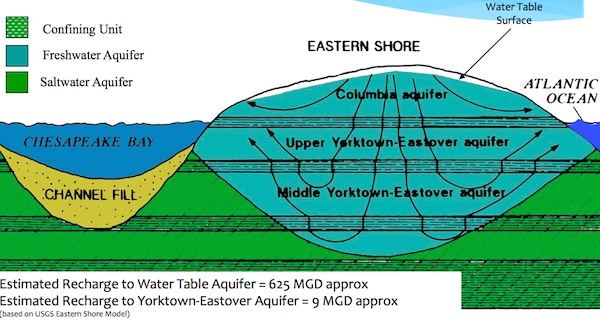
There’s a limited supply of groundwater in the Cape Charles vicinity, and the town needs to prepare to deal with saltwater intrusion now. That’s according to Elaine Meil of the Accomack-Northampton County Planning District Commission, who addressed the Cape Charles Planning Commission June 30. Meil said the problem is still a few years away, but that the town needs to begin planning for it.
According to groundwater modeling done by the United States Geological Survey, “saltwater intrusion can be expected in town wells over time and the town should be aware of this problem,” Meil said, adding that:
- Groundwater studies have shown limited groundwater in the Cape Charles vicinity. This is a natural feature of the area.
- The Eastern Shore of Virginia Ground Water Committee works extensively on groundwater issues and they have funded the USGS to develop a groundwater model. This model is the best source of information regarding changes to groundwater in the Cape Charles area.
- Long term, the Town may need to change water treatment technologies or obtain water from the Eastville area of Northampton County or possibly from the southern tip.
Town staff has applied to renew the 10-year DEQ (Department of Environmental Quality) Groundwater Withdrawal Permit at 68 million gallons per year, a reduction from 252 million gallons per year. The current use is just under 40 million gallons per year, Meil noted. [Read more…]
EDITORIAL: Drop the Speed Limit to 45
A CAPE CHARLES WAVE EDITORIAL
July 21, 2014
How many more people have to die, how many more vehicles must be destroyed, how many more close calls must there be before VDOT awakes to the deadly danger of Route 13 north and south of the Cape Charles traffic light? If Route 13 is Virginia’s most dangerous highway, we will nominate the Cape Charles/Cheriton area as the most dangerous patch of it.
The traffic light itself is not the problem so much as the multiple turnoffs mostly south of the light. Two of our neighbors had their cars totaled in the past few years — one trying to cross the highway to get to the Corner Mart, the other a victim of someone pulling out from McDonald’s directly in front of her.
Last week we saw something new and scary: a full-size charter bus leaving McDonald’s was trying to turn left onto Route 13. Judging by the line of cars behind the bus, the driver had to wait a long time for a break in the traffic.
Why does the speed limit drop to 45 mph on the bypass around Exmore but not in the Cape Charles/Cheriton area? The danger here is arguably worse than in Exmore (which funds their entire Police budget from speeding tickets).
Our most recent heart-stopper (and the inspiration for this editorial) came from waiting in the left-hand lane on 13 to turn onto Stone Road. An 18-wheeler roared past at full speed only a few feet away, violently shaking our stopped van in the jet stream. We were literally “sitting ducks.” And as everyone knows, a 55 mph limit means it is your God-given right (and duty) to drive 60 — and this trucker was doing his duty.
At least we were encased in a two-ton van; pity the pedestrian who tries to navigate that death-trap. Earl Wayne Spady was hit by a truck last month while trying to cross Route 13 on foot at night. May he rest in peace. [Read more…]
WAYNE CREED
Wake Up to Danger of Saltwater Intrusion
By WAYNE CREED
July 21, 2014
A few nights ago, plagued by a fit of insomnia, I downloaded a copy of the Cape Charles Planning Commission’s June 30 meeting agenda. Hoping the content would induce a much needed sleep, I quietly perused the document. As usual, it was filled with the same vapid and gooey pap that has come to define the Natali-McCoy Planning Commission. There was some talk of promoting a museum for the Chesapeake Bay Impact Crater, but then, buried deep down in the weeds, a discussion of saltwater intrusion, and how it will affect the Town. In a cavalier, dim, nonchalant tone, it states:
The Town has limited groundwater resources. In the future, saltwater intrusion may necessitate the Town update water treatment technologies or possibly obtain water from a different location.
So, what are they talking about? In a nutshell, saltwater intrusion (high concentrations of total dissolved solids making it unfit for human consumption) is the movement of saline water into freshwater aquifers. Aquifers are saturated geologic materials that yield usable quantities of drinking water to wells. In our case, we rely on the Columbia and Yorktown-Eastover aquifers and there are no other viable economical alternative drinking water sources. The Columbia and Yorktown-Eastover aquifer is considered highly vulnerable to salt water contamination due to the high levels of ground-water pumping from coastal wells (like our Keck wells). As towns like Cape Charles continue to over-develop (large developments such as Bay Creek ), ground-water use increases to the point that these areas become vulnerable to contamination and brings into question the viability of ground-water sustainability.
Well drillers around here can attest to the abundance of bad-tasting ground water in parts of southeastern Virginia– a large body of salt water, known as a salt water wedge has been blamed for undrinkable ground water that extends from the mouth of Chesapeake Bay into the Columbia and Yorktown-Eastover aquifers. For many years, scientists thought the wedge was caused by the incomplete flushing of ancient seawater that had invaded the aquifers during high stands of the sea. Understanding of Virginia’s inland saltwater wedge changed in 1993 when David Powars of the U.S. Geological Survey and geologist C. Wylie Poag, while studying the Atlantic Coastal Plain made an important discovery. Deep sedimentary cores identified a large impact crater formed by a meteorite near what is now the mouth of Chesapeake Bay ( three times larger than any other U.S. crater and the sixth largest crater known on Earth). [Read more…]