Town Staff Recommends Allowing Backyard Chickens
CAPE CHARLES WAVE
February 3, 2014
The Cape Charles Planning Commission will consider a draft ordinance to regulate backyard chicken-keeping 6 p.m. Tuesday, February 4, at Town Hall. Public comments will be heard.
Town Planner Rob Testerman’s report lists both benefits and concerns about backyard chickens. He notes that most communities that allow chickens do not allow roosters, and recommends against that in Cape Charles as well.
Testerman says benefits of egg-laying hens are: fresh and healthful eggs, companionship as pets, fertilizer for the garden, insect and weed control, and community building of like-minded chicken owners.
On the downside, Testerman reports, even hens make noise, although much less than a barking dog. Chickens can smell if the coop is not cleaned regularly, and salmonella could be a risk to the people handling the chickens if they are not cared for properly.
Escaped chickens, chicken predators, and pests drawn to chickens could be addressed by requiring proper enclosures and rodent-proof containers for chicken feed, he suggests.
Property values in communities that allow chickens often increase, Testerman reports. But he recommends against allowing the slaughter of chickens in residential neighborhoods. [Read more…]
Panek Resigns PSA Chairmanship, Remains on Board
By GEORGE SOUTHERN
Cape Charles Wave
February 3, 2014
After Northampton County Board of Supervisors voted January 27 to “stop all future funding until there is a change of leadership in the PSA,” the County’s Public Service Authority was scheduled to meet the next night – the night of the “blizzard.” PSA Chairman Bob Panek said he thought it was important not to cancel the meeting, but not enough members made it through the snow to obtain a quorum.
Panek wrote a memo to the PSA board members the next day, announcing his resignation as chairman. He did not, however, resign from the Board.
Vice-chair J.T. Holland will assume Panek’s duties until the Board elects a new chairman.
In his resignation memo, Panek said he found it “curious” that the County Board of Supervisors chose to end his leadership the way it did. “A simple phone call would have achieved the same thing,” he wrote.
According to a report in the Eastern Shore News, Panek told a reporter that he had no [advance] knowledge of what the Supervisors were going to do. Panek later wrote in his memo that he discussed the action January 28 with Board of Supervisors Chairman Larry LeMond, who he said told him that the “perceived conflict of interest was due to my close association (part time employee) with the Town of Cape Charles.”
Cape Charles Town Council appointed Panek to serve on the PSA in his capacity as a private citizen, even though he is also the Assistant Town Manager, with oversight responsibility for the Town’s water and wastewater facilities. With dual responsibilities, Panek worked to obtain an agreement between the Town and the County to pipe sewage from Route 13 to the Town. However, when the County sought a rate structure from the Town, the Town’s expert, Panek, had to recuse himself. The County is still waiting for a rate structure. [Read more…]
DINING: Eastville Inn Adds Imagination to Tradition

Creamy Mascarpone Laced Polenta (Photos by Clarice MacGarvey)
By CLARICE MACGARVEY
Cape Charles Wave
February 3, 2014
If your palate enjoys surprises, put Chef Brent Schmidt and the Eastville Inn on your dining radar. The historic Inn, built in 1724, began life as a roadside Coach House in Colonial times, offering overnight accommodations as well as dining for travelers. Today, the sprawling hotel bedrooms located on the upper story of the Inn are closed. The primary floor, consisting of a large main dining room, a smaller, more private dining space, and a cozy lounge, is very much open—providing an upscale dining experience that is rare on the Eastern Shore.
Chef Schmidt, a native of Hampton Roads with strong family ties to the Shore, took over this landmark facility in June 2013, updating the décor and adding high-top tables, a bar, and bar seating to the rear lounge overlooking the Colonial herb garden. The lounge area previously served as a display room for artifacts found in or near Eastville, showcasing the Shore’s legacy as one of Virginia’s earliest shires. The artifacts can now be viewed in the spacious entry hall, making space in the lounge for a comfy sofa and chair for chatting or enjoying a pre-dinner cocktail. The Inn’s bar serves a full range of popular cocktails and specialty martinis (try the Flirtini or Spiced Pear) along with champagnes and some very nice wines from Australia, Italy, New Zealand, Argentina, California, and the Shore’s own local winery, Chatham Vineyards.

Pan seared prawns
As an historic landmark, on the National Register of Historic Places, the Inn must maintain authenticity in specific areas of décor and structural detail. This includes draperies and wall paint color tones. Schmidt has added counterpoint to the Inn’s soft yellow walls with rich burgundy table linens and a collection of nicely hung art by local artists. With the warm wood flooring and pristine white molding and support pillars, the dining room fully evokes Southern hospitality. And the friendly, well-trained staff delivers on that promise.
I have been to the Inn multiple times, and on each visit have discovered a new taste sensation. Schmidt is a talented and imaginative chef with a real knack for unexpected flavor pairings, including his soup and appetizer creations. On my last visit, a chilly Saturday night in mid-January, the soup du jour was “Loaded Potato,” a rich and hearty blend of potato, apple wood-smoked bacon, corn, and spinach. It was pleasantly seasoned, appropriately thick and creamy, and topped with Cheddar-Jack cheese and sour cream. Also popular is Schmidt’s “not so traditional” French Onion Soup, with a unique base that delivers a nice flavor twist. [Read more…]
COMMENTARY: Why We Might Join the Beach Club
By WAYNE CREED
February 3, 2014
The review of the new Beach Club at Bay Creek in the Wave, which at first appeared to be a rather innocuous report about the general status of the facility, instead seemed to unleash a firestorm of commentary. As usual, the comments section veered off into the weeds, degenerating into a Wrucke vs. Bender UFC cage match, arguments of gated vs. non-gated communities, Bay Creek’s inability to clear snow off the roads, the Wave’s journalistic style, and even intellectually flaccid attacks against members of Old School Cape Charles.
While all this was going on, my wife was reading the article with excitement — years of working in social work, she is the original inspiration for a silver linings playbook. While I’m complaining, “Where’s the bar? How am I going to get my martinis? Do they expect me to survive on just food and water? Never!,” she’s reviewing the amenities, and quite to my surprise offers, “You know, this place is great. And it’s a great deal. Cheaper than the Y.” Stopping me in my tracks, I asked her, “What you talkin’ bout Willis?”
And then she explained. When she was a kid, she belonged to a pool and racquet club in Northern Virginia. In the summers she would spend her days playing tennis, walking over to Roy Rogers for fried chicken, and generally just lounging by the pool. She would also spend one or two weeks visiting cousins in California, who belonged to a magnificent beach club overlooking the Pacific, just north of San Diego. At that moment, I realized that she wasn’t just trying to be Pollyanna — her memories of those times really did make her happy.
Then I thought of my own youth. We also belonged to a club. Looking back, it probably wasn’t much to look at, and compared to what we see at Bay Creek, probably a bit shabby. But it had a big, clean pool, a couple of tennis courts, game room with pool, ping-pong, a few pinball machines, and an excellent snack bar. When Little League baseball ended in mid-June, we were finally cut loose, free to indulge in the lazy days of summer. Me and my friends would sleep late, and then hop on our bikes and ride over to the pool. Pockets stuffed with lawn mowing money, we would swim, play ping-pong, and eat hot dogs and coke all day, until exhausted, we trekked back home to Mom’s dinner table.
Sometimes during the week, when the pool was marginally empty, me and my friend Ronnie would take his dad’s scuba equipment, and the life guard would let us scuba dive in the pool (as long as they could see us). I’m not sure how many hours you need to be certified to dive, but I’m months past that. Ronnie and I would stay under until we completely drained the tanks. Later we would carefully return them to the racks, and Saturday morning, when Ronnie’s dad was checking them before he went on a dive, after discovering they were empty, we could hear his yell, echoing throughout the neighborhood, “RONNIE!” [Read more…]
1999 BALTIMORE SUN: Real Estate, Development Boom Reawakens Cape Charles
February 3, 2014
EDITOR’S NOTE: The story below appeared 15 years ago this week in the Baltimore Sun. On its anniversary, the Wave is highlighting it as one more intriguing look from a “back to the future” perspective.
By CHRIS GUY
Baltimore Sun
February 07, 1999
CAPE CHARLES, Va. — More than a century after two railroad men from up north put the place on the map — literally — the future is beginning to look a lot like the past in this bay-front town near the southern tip of Delmarva.
“For Sale” signs are sprouting on residential and commercial properties, and newcomers are snapping up second homes, investment properties and rentals so fast that local real estate agents can barely keep up.
There’s not a block among the perfectly square 644 lots laid out in 1883 by New York, Pennsylvania & Norfolk Railroad executive William L. Scott that hasn’t attracted interest.
Isolated for years by a $10 one-way toll to make the 30- to 40-minute trek across the Chesapeake Bay Bridge-Tunnel to Norfolk, Virginia Beach and other Hampton Roads cities, the southernmost town on the Delmarva Peninsula is no longer a secret.
Cape Charles’ pristine Chesapeake Bay beach and stately late-Victorian homes are drawing increasing numbers of well-heeled investors looking for weekend getaways, says Kim Starr, a New Jersey native who first came to Virginia’s Eastern Shore 15 years ago.
The weekenders are coming not only from the Hampton Roads area, about 25 miles away, but also from Baltimore, about 205 miles away.
“People say that the bridge-tunnel toll is our serenity tax,” says Starr, who [formerly was] married to six-term Town Councilman Frank Wendell. “It has kept us from becoming a bedroom community of Virginia Beach. But more recently, people have discovered that despite the toll, we have the benefit of living in a small town that’s just a hop, skip and a jump from a major metropolitan area — the best of both worlds.”
Investors willing to take a chance have found Cape Charles a good risk, Starr says, citing a Charlottesville, Va., couple — both lawyers — who bought two small homes for about $83,000, then sold them for $132,000 in just a few months. The couple used the profit to buy a second home close to the town’s public beach.
After decades of decline that left Cape Charles a ragged shell of the booming rail, steamship and ferry hub that once was the Virginia Shore’s most important town, business and community leaders say their newfound optimism is fueled by more than a surging real estate market.
The bed-and-breakfast inns, restaurants and shops that have opened in the past few years have provided a boost, merchants say. But it is an innovative “eco-industrial park” and a nearly 2,000-acre golf course community, conference center and resort that will soon lift Cape Charles and Northampton County — one of Virginia’s poorest — into prosperity not seen since the town’s pre-World War II heyday, supporters say. [Read more…]
VIDEO: Cape Charles Snow Day
January 30, 2014
We take a drive down Mason Avenue and over the Hump so you don’t have to. (Click bottom right of window for full screen view.)
COUNTY SUPERVISORS FIRE PSA CHAIRMAN PANEK

Bob Panek at last September’s PSA information meeting at the Cheriton Fire Hall. He did not attend yesterday’s Board of Supervisors meeting. (Wave photo)
PSA Funding Is Stopped Until Change of Leadership
By GEORGE SOUTHERN
Cape Charles Wave
January 28, 2014
Northampton County Board of Supervisors effectively ended Bob Panek’s Public Service Authority chairmanship yesterday by voting to “stop all future funding until there is a change of leadership in the PSA.” Newly elected Board Chairman Larry LeMond made the motion, which was seconded by Larry Trala and passed unanimously.
The previous Board Chairman, Willie Randall, had maintained that the Supervisors had no power to dictate who chairs the PSA, because PSA members elect their own chairman. Randall lost his seat in the November election to Granville Hogg, and the deciding factor in that upset seems to have been the PSA issue.
The new Board of Supervisors simply used the power of the purse. The PSA is financed wholly by the County, and without funds it can do nothing. Although Panek technically remains chairman, a refusal by him to step down would be a Pyrrhic victory, since the PSA could no longer function.
The opposition to Panek centered on the fact that he is also the assistant town manager for the Town of Cape Charles. A Wave editorial (click to read) addressed the issue last September, maintaining that Town Council’s appointment of Panek to the PSA “violates the principle of separation between a paid public employee and an elected or appointed official.”
Under Panek’s leadership, the PSA turned a deaf ear to public outcry. Last September 17, some 100 residents came to the Cheriton Fire Hall to oppose PSA plans to establish a sewer district around the Route 13-Cheriton area that could increase property taxes in the special district by almost 100 percent. Despite the universal outcry at the meeting, the PSA met immediately afterward to unanimously approve a $70,000 contract with the engineering firm Hurt & Profitt to begin surveying the sewer project. [Read more…]
ORAL HISTORY: A Chat with Alston Godwin
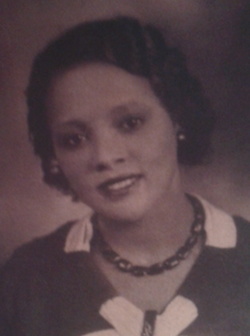
Alston Godwin as a young adult
January 26, 2014
(EDITOR’S NOTE: Cape Charles Historical Society has for more than a decade been recording oral histories of the area’s earlier days. In 2008, Bill and Jan Neville interviewed Alston Godwin, who was then 96. Mrs. Godwin lived to be 101, and her obituary may be read by clicking here.
A grant from the Virginia Foundation for the Humanities enabled 15 interviews to be transcribed, and the Historical Society has made this one available for readers of the Wave. All the transcriptions may be read at the Cape Charles Museum.)
Excerpts from an interview with Bill and Jan Neville, March 12, 2008
Entering the Funeral Business
The Funeral business started, my aunt and uncle [Mills Grey] established that business. I don’t think Uncle Mills was born here. But anyway, he and my aunt were very lovable people, lovable to each other and all the people they came in contact with. He learned people and he worked to do that. He established himself and his memory was good for everything he had ever heard or seen. And so then, he got married and established his business. It was the first black business in Cape Charles. They had one white undertaker. This was in 1895. My aunt stuck right by him. She learned from him what he was doing, but he didn’t have her embalm and she didn’t want to embalm. And you know, I didn’t either! I’d work to do anything but that. I didn’t care for that. My daughter, Jennie Marie, used to hang around them. She wasn’t afraid of no dead people.
Now I’ll tell you how I came to [enter the funeral business]. My first year in college, we were having our Christmas vacation and I came home and Uncle Mills had just died and been buried. He hadn’t been buried very long and I said to my mother, ” Mama I think I would like to go spend a couple nights with Aunt Jenny.” She said, “I think Alston that’s a good idea.” So I went there and I was an excellent driver. I could drive anywhere. So then I went and when I got there, sure enough, she had a call out. And I drove the hearse for her. And she and I went and got the body. She went with me. Because she worked with her husband, too. She was with him all the time. So then I saw a need that I had to stay longer. I was going to stay there until this body was buried. My aunt wasn’t up to it.
Bill Neville: She didn’t have anybody else to help her after her husband died?
Oh yes, back then that’s one good thing. There was not a neighbor, white or black, that wouldn’t come if you called and do anything to help you. And they’d come and cook for her. I didn’t have to do any cooking. But I wanted to because I didn’t want to forget how to cook. Then I used to give them dinners and things to eat. [Read more…]